
Losing a tooth — whether to decay, injury, or gum disease — does more than change your smile. Over time, the jawbone beneath a missing tooth begins to resorb, meaning it gradually shrinks because it no longer has a tooth root stimulating it. Adjacent teeth can drift into the gap, altering your bite. Chewing patterns shift. It’s a chain reaction that most people don’t anticipate, and it’s exactly why how you replace a missing tooth matters as much as whether you replace it. Dental implants are the only tooth replacement option that addresses the problem at its root — quite literally.
At Interlachen Dental, implant consultations are some of the most rewarding conversations we have with patients. There’s often a mix of curiosity and apprehension walking in, and by the end, most people leave with a clear picture of a solution that’s more straightforward — and more durable — than they expected. If you’ve been wondering whether implants might be right for you, here’s what you actually need to know.
What a Dental Implant Is Made Of
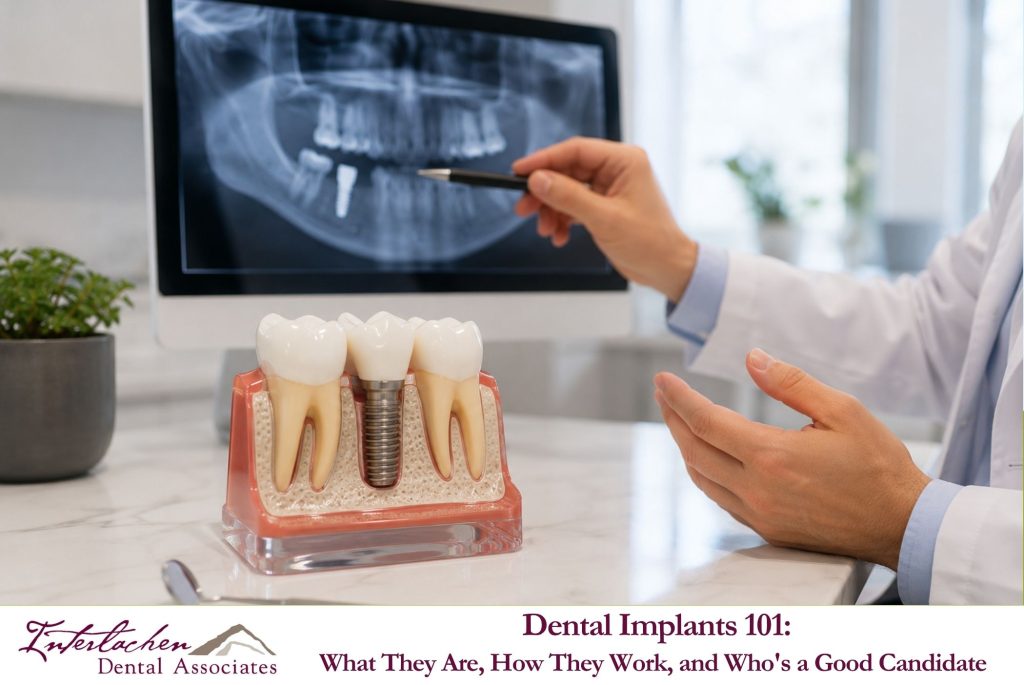
A dental implant is a three-part system. The implant fixture itself is a small titanium post — typically 3 to 5 millimeters in diameter — that is surgically placed into the jawbone to serve as an artificial tooth root. Titanium is used because of its biocompatibility: the bone accepts it readily and grows around it through a process called osseointegration, creating a stable, permanent anchor over the course of three to six months.
Once osseointegration is complete, an abutment — a small connector piece — is attached to the top of the implant post. This serves as the foundation for the final restoration. That restoration is most commonly a porcelain crown, custom-fabricated to match the color, shape, and size of your surrounding teeth. The end result is a replacement tooth that looks, feels, and functions like a natural one — including the ability to bite and chew without restriction.
Who Is a Good Candidate for Dental Implants
The most important factor in implant candidacy is bone volume. Because the implant fixture needs sufficient jawbone to integrate into, patients who have experienced significant bone loss — often the result of a tooth being missing for an extended period — may require a bone graft procedure before implant placement is possible. A graft introduces bone material to the deficient site, allowing it to rebuild density over several months. It adds time to the overall process, but it makes implants accessible to patients who might otherwise be ruled out.
Beyond bone volume, overall health plays a role. Uncontrolled diabetes, active periodontal disease, and certain medications that affect bone metabolism can complicate healing and are factors we evaluate carefully. Smokers have a higher rate of implant failure due to compromised circulation and slower tissue healing — quitting before and during treatment significantly improves outcomes. Age is generally not a barrier; implants are placed routinely in patients in their 70s and 80s with excellent results, provided bone and health criteria are met.
The Implant Timeline: What to Expect
One of the most common questions we hear at Interlachen Dental is how long the whole process takes. Honest answer: it varies, but a straightforward single-tooth implant from placement to final crown typically spans four to eight months. The majority of that time is passive — you’re simply waiting for osseointegration to occur while going about your normal life. The surgical appointments themselves are shorter than most patients anticipate, performed under local anesthesia with minimal discomfort during the procedure.
Post-placement recovery is generally manageable. Some swelling and tenderness in the first few days is normal and well-controlled with over-the-counter pain medication in most cases. We monitor healing at regular intervals and only move to the crown phase once we’ve confirmed the implant has fully integrated. Rushing that timeline compromises the outcome, so patience during the healing phase pays real dividends in longevity — implants that are properly placed and cared for routinely last 20 years or more.
Schedule a Consultation Today!
If you’re missing a tooth — or facing an extraction and weighing your options — a consultation is the best place to start. We’ll take a cone beam CT scan to assess your bone volume in three dimensions, walk you through exactly what your treatment would involve, and give you a realistic timeline and cost estimate. Reach out to Interlachen Dental to schedule your implant consultation, and let’s build a plan that gives you a tooth built to last.